
The cost of living in Dubai for doctors is the question every UK-trained physician asks before they apply and rightfully so. Moving from the NHS to Dubai is not just a career decision; it is a financial one. This guide gives you real numbers: what you earn, what you spend, and exactly how much you can save so you can make a confident, informed decision in 2026.
In This Guide
- Why the cost of living in Dubai feels different for doctors
- What UK & international doctors earn in Dubai (2026)
- Monthly expenses: category-by-category breakdown
- Real monthly budget: 5 doctor profiles
- DHA licensing costs: what no one tells you
- India to Dubai: the doctor’s cost comparison (INR)
- Living in Dubai Healthcare City
- Hidden costs doctors consistently miss
- 2026 trends: is Dubai getting more expensive?
- 10-year financial projection: Dubai vs UK
- Frequently asked questions
Why the Cost of Living in Dubai Feels Different for Doctors
The single biggest factor UK and international doctors overlook is the zero income tax environment. Under UAE Federal Decree-Law No. 47 of 2022, there is no personal income tax in the UAE. Every dirham you earn, you keep.
A UK GP earning £70,000 per year takes home approximately £4,200 per month after tax and National Insurance contributions. The same doctor earning an equivalent AED 32,000 per month in Dubai takes home every penny roughly £6,900 per month at current exchange rates. That is a 64% increase in take-home pay before a single expense is considered.
When you add employer-covered housing allowances (AED 5,000–15,000/month), school fee contributions, and annual flight allowances all standard components of a Dubai hospital contract the financial gap widens further still.
DrExpat Placement Insight (2025–2026): Based on doctors we have placed across Dubai over the past 12 months, UK-trained GPs and specialists consistently report saving AED 12,000–25,000 more per month in Dubai than they saved in the UK on a comparable gross salary primarily due to zero tax and employer-covered housing. Most describe the move as the best financial decision of their career.
What UK & International Doctors Earn in Dubai (2026)
The table below shows tax-free salary benchmarks by role, with GBP and INR equivalents for comparison. All Dubai figures are 100% take-home no deductions.
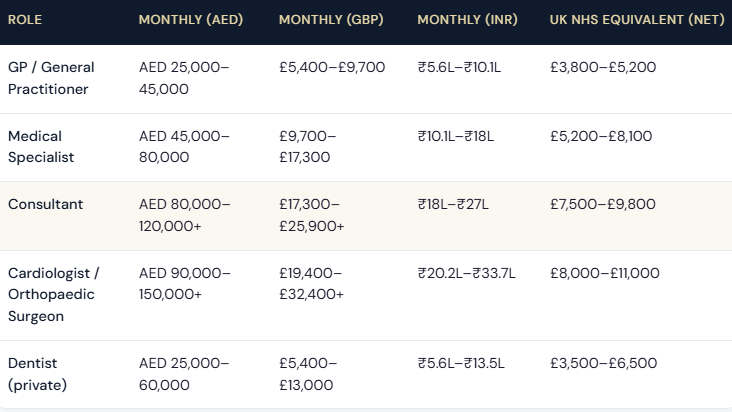
All Dubai figures are tax-free. UK NHS figures are post-tax estimates based on 2026 HMRC bands. Exchange rates used: 1 AED = £0.216; 1 AED = ₹22.5.
Important for UK CCT holders: Doctors with a Certificate of Completion of Training from the UK are often eligible for Consultant-level DHA classification without sitting the Prometric exam, meaning you can enter at the highest salary tier from day one. DrExpat will confirm your eligibility as part of our free assessment.
Standard package components to negotiate
Dubai hospital salaries come with a package beyond base pay. Always negotiate every component — not just base salary:
- Housing allowance: AED 5,000–15,000/month (or employer-provided accommodation)
- Education allowance: AED 20,000–50,000 per child per year
- Annual flight allowance: 1–2 return flights to home country per year
- Health insurance: Mandatory — employer covers for employee; family at subsidised or zero cost
- Professional development: CME allowance AED 5,000–15,000/year at larger groups
- Gratuity: End-of-service benefit (UAE Labour Law) — 21 days’ salary per year for the first 5 years
Monthly Expenses: Category-by-Category Breakdown
Housing Where Doctors Actually Live
Housing is your largest variable cost and the one over which you have the most control. Where you choose to live should balance rental cost, commute to your hospital, and family needs. Below are the most common areas for doctors in Dubai in 2026.
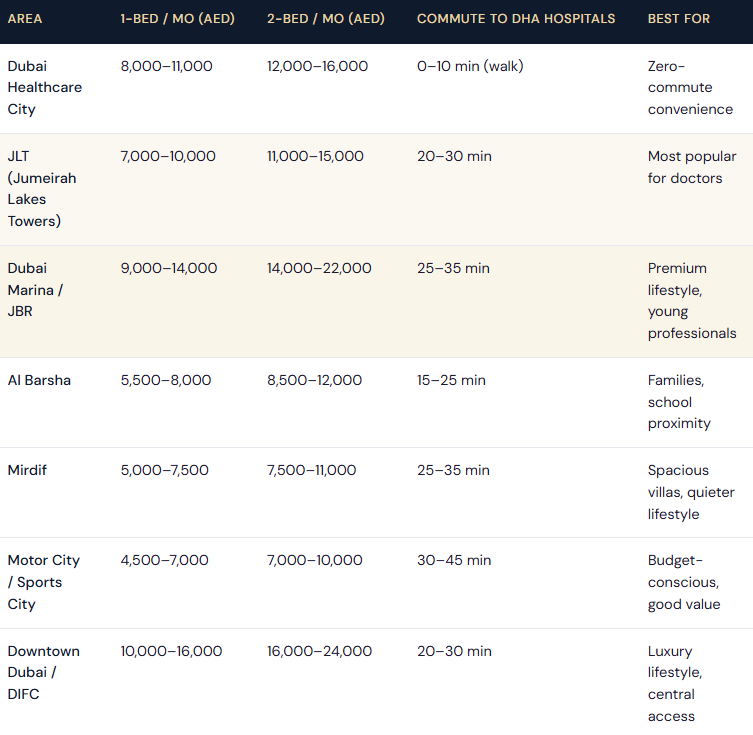
Most hospital employer contracts include a housing allowance of AED 5,000–15,000/month. If your allowance covers AED 8,500 and you choose Al Barsha, your net housing cost may be zero. That is AED 102,000 in annual compensation you would otherwise miss.
International School Fees
There are no free state schools for expat children in Dubai all children attend fee-paying private schools. This is the largest variable cost for families and the most important element to negotiate at offer stage.
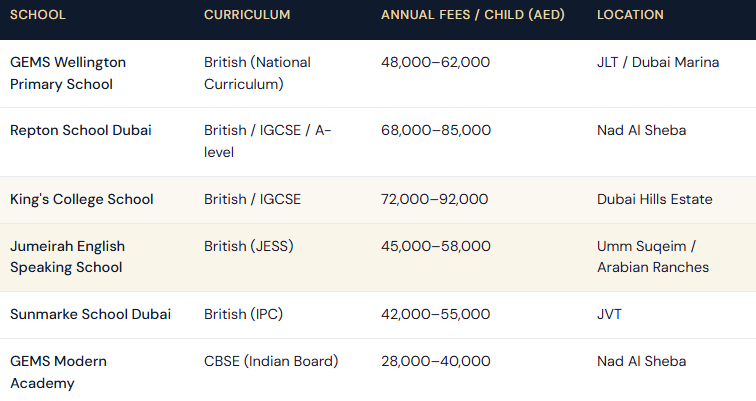
Employer education allowances of AED 20,000–50,000 per child per year are standard at larger hospital groups. This rarely covers full fees but significantly reduces the gap. DrExpat negotiates this as a priority it can add AED 40,000–100,000 to your effective annual compensation for a family with two children.
Transport
Petrol in Dubai costs approximately AED 2.43 per litre less than half UK pump prices. Monthly car lease runs AED 2,000–3,500. Many hospitals provide shuttle services for shift workers. The Dubai Metro and bus network covers central areas well.
Budget for: car lease AED 2,000–3,500 + petrol AED 400–600 + Salik road toll AED 200–400 + parking AED 100–300 = AED 2,700–4,800/month total.
Food & Groceries
Carrefour, Lulu Hypermarket, and Union Coop are broadly comparable to UK Tesco/Asda pricing. Spinneys and Waitrose carry imported UK brands at 20–40% premium. Mid-range restaurant dinner: AED 80–150 per person. A typical family groceries and dining budget: AED 2,500–5,000/month.
Utilities & Bills
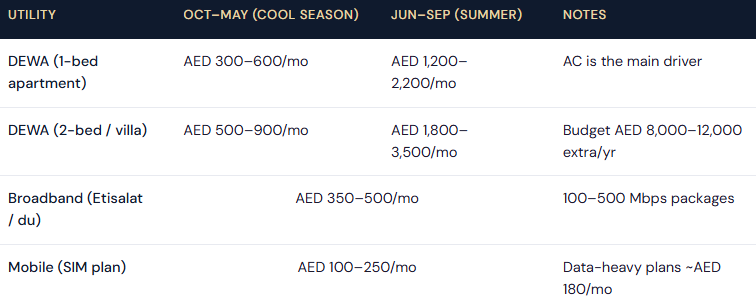
DEWA (Dubai Electricity and Water Authority) bills are low in winter but spike dramatically in summer due to air conditioning demand. Broadband and mobile add AED 400–750/month.
Healthcare for Your Family
Your employer-provided mandatory health insurance covers you at zero cost. Family coverage is usually included or offered at subsidised rates. Unlike the UK, you access private consultants instantly with no waiting lists. Dental typically requires a top-up plan (AED 150–300/month). Budget for: AED 0–800/month for family healthcare top-ups.
Real Monthly Budget: 5 Doctor Profiles
Here is what the numbers look like in practice. These scenarios use 2026 AED benchmarks and reflect typical DrExpat-negotiated packages.
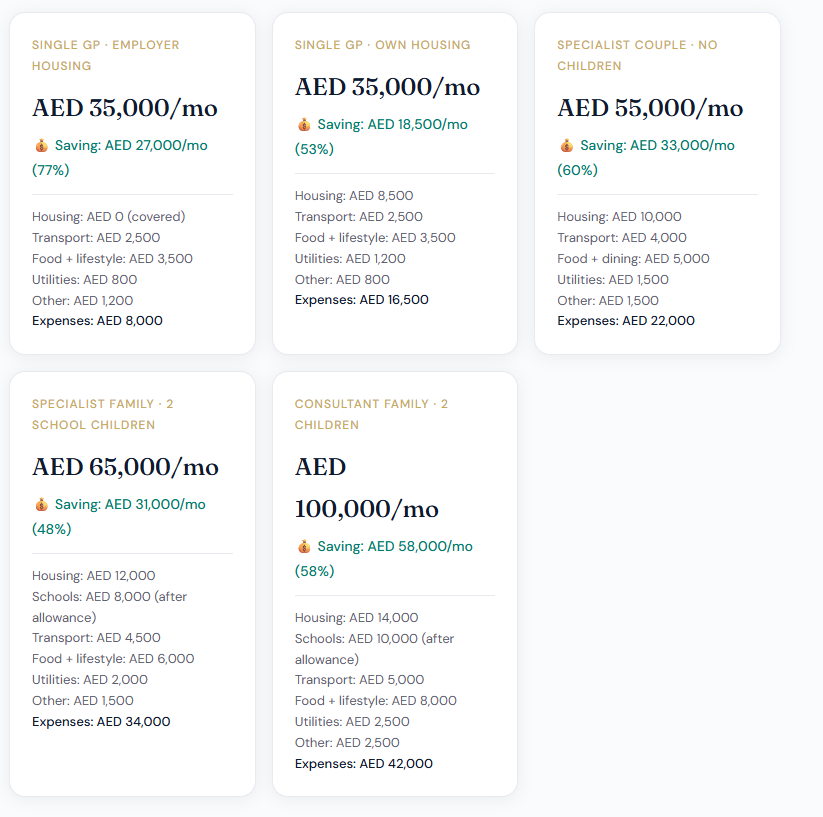
Most UK doctors placed through DrExpat save between 35% and 77% of their doctor salary in dubai compared to the 10–15% typical in the UK, even on high NHS salaries. The key variables are housing (covered by employer or not) and whether you have school-age children. Both are negotiable at offer stage.
DHA Licensing Costs: What No One Tells You
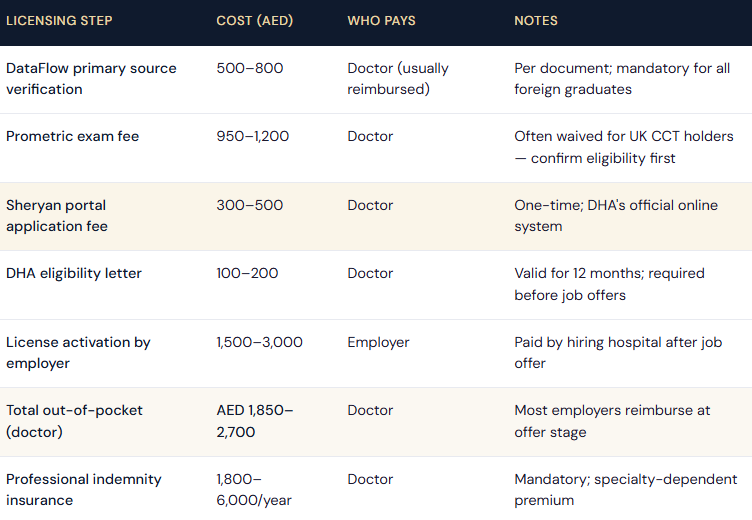
Every competitor cost-of-living guide ignores the upfront cost of actually getting to work in Dubai. For doctors, that means DHA (Dubai Health Authority) licensing. Here are the real 2026 costs and who pays what.
DHA vs DOH vs MOH — which licence do you need?
- DHA: Required to practise in Dubai (all private and government hospitals in Dubai emirate)
- DOH: Required for Abu Dhabi separate process, broadly similar fees
- MOH: Required for other emirates (Sharjah, Ajman, RAK, Fujairah)
UK CCT holder advantage: If you hold a Certificate of Completion of Training from the GMC-recognised UK system, you may be exempt from theDHA Prometric exam saving approximately AED 1,200 and 2–3 months of preparation time. DrExpat confirms eligibility for every UK candidate as the first step of our process.
India to Dubai: The Doctor’s Cost Comparison (INR Edition)
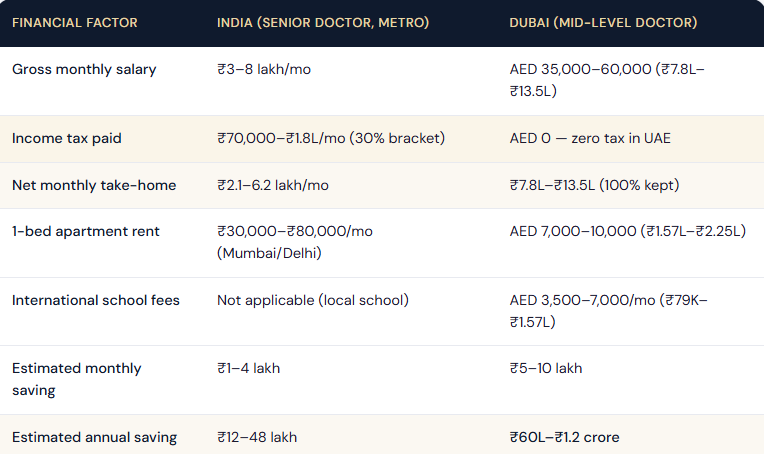
India is home to over 1.3 million registered doctors, and thousands make the move to Dubai every year. If you are weighing a career in Dubai against a senior hospital role in Mumbai, Delhi, Bengaluru, or Hyderabad, the numbers tell a clear story but only when you see them in rupees.
Relocation costs from India to Dubai (one-time)
- Return flights (family of 3): AED 3,000–6,000 (₹67,000–₹1.35L)
- Shipping / excess baggage: AED 8,000–20,000 (₹1.8L–₹4.5L)
- Security deposit for apartment: AED 10,000–20,000 (₹2.25L–₹4.5L)
- UAE visa for family dependents: AED 3,000–5,000/person (₹67K–₹1.12L each)
- DHA licensing (out-of-pocket): AED 1,850–2,700 (₹42K–₹61K)
Timeline for Indian doctors: DHA licensing from India typically takes 4–6 months. An MBBS + MD/MS from an MCI/NMC-recognised institution is accepted. DataFlow verification is mandatory. DrExpat has helped hundreds of Indian-trained doctors navigate the full process.
Three-year perspective: An Indian specialist who saves ₹15–20 lakh per year in India can realistically save ₹60–80 lakh per year in Dubai on a comparable role. Over three years, that is a ₹1.8–2.4 crore difference enough to pay off a home loan, fund children’s education, or build a substantial investment portfolio.
Living in Dubai Healthcare City
Most Dubai cost-of-living guides treat the city as a single place. For doctors, it is not. Dubai Healthcare City (DHCC) is the world’s largest dedicated healthcare free zone, home to Mediclinic City Hospital, Aster Hospital, and over 120 specialist outpatient clinics. If you are placed there, your cost-of-living equation is fundamentally different from the average expat’s.
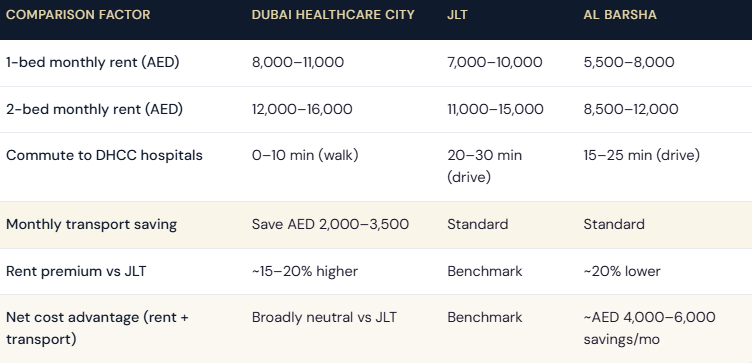
The rent premium in DHCC is essentially offset by eliminating car costs. Many DHCC-based doctors report a significant improvement in work-life balance from the zero-commute lifestyle, particularly during the demanding early months of settling into a new role.
Setting up a private clinic in Dubai Healthcare City
For doctors considering private practice — either immediately or after building UAE experience DHCC is the primary location for outpatient clinics. Setup costs:
- DHCC commercial clinic rent: AED 8,000–25,000/month (depending on size and fit-out)
- Initial fit-out and equipment: AED 80,000–250,000 (one-time)
- DHCA (Dubai Healthcare City Authority) licensing: AED 15,000–30,000 (setup)
- DHA clinic operating licence: AED 5,000–12,000/year
- Malpractice/professional indemnity insurance (clinic): AED 8,000–25,000/year
2026 Trends: Is Dubai Getting More Expensive?
The short answer: modestly yes, but slower than in 2024–25. Here is what the data shows.
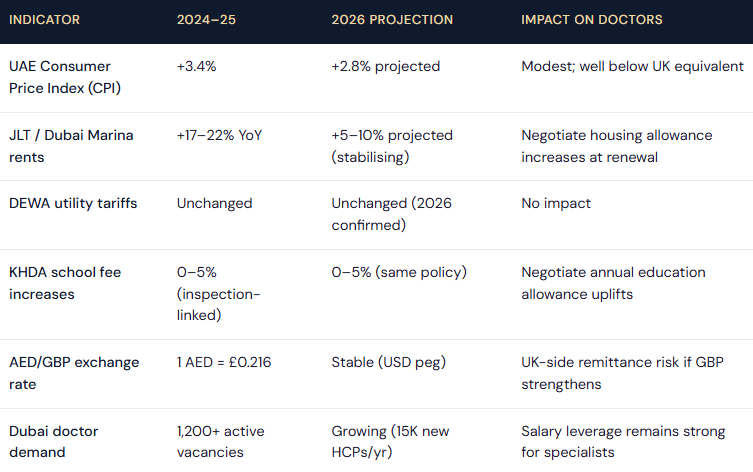
Dubai’s rental market peaked in mid-2024 and is showing signs of stabilisation in 2026, particularly in areas outside the prime marina districts. Motor City, Mirdif, Al Barsha, and JVC are delivering better value-for-money than they did 18 months ago. For doctors relocating in 2026, the rental outlook is more favourable than it was for those who moved in 2023–24.
The UAE Golden Visa for doctors: Doctors earning AED 30,000/month or more are eligible for the UAE 10-year Golden Visa. The one-time cost is approximately AED 3,000–4,500. This provides long-term family stability, eliminates repeated visa renewal fees, and opens the door to property investment and long-term financial planning in the UAE — a compelling option for doctors who plan to build a career of 5+ years in Dubai.
10-Year Financial Projection: Dubai vs UK
For context, here is what the numbers look like over a decade for a Consultant-level doctor choosing between the NHS and Dubai — assuming consistent saving rates and no investment returns (cash savings only).
| Year | UK Consultant (saving £1,500/mo) | Dubai Consultant (saving AED 50,000/mo = ~£10,800/mo) | Dubai advantage |
|---|---|---|---|
| Year 1 | £18,000 | £129,600 | +£111,600 |
| Year 2 | £36,000 | £259,200 | +£223,200 |
| Year 3 | £54,000 | £388,800 | +£334,800 |
| Year 5 | £90,000 | £648,000 | +£558,000 |
| Year 10 | £180,000 | £1,296,000 | +£1,116,000 |
Cash savings only; excludes investment returns, pension, property equity, or compounding. NHS Consultant saving estimate based on £9,800/mo net with typical UK outgoings. Dubai Consultant assumes AED 100,000/mo salary, AED 50,000/mo savings.
Is Dubai Worth It for UK Doctors?
For most UK doctors, the answer is yes.
With tax-free income, higher salaries, and benefits like housing and schooling allowances, doctors can save more in 2–3 years in Dubai than in a decade in the UK.
Frequently Asked Questions
1. Is 20,000 AED a good salary in Dubai?
Yes, AED 20,000 per month is considered a good salary for a single person in Dubai. It allows a comfortable lifestyle with savings of AED 5,000–10,000 depending on rent and lifestyle choices. For families, it may be tight unless housing or schooling is covered.
2. How much money do you need to live comfortably in Dubai?
To live comfortably in Dubai:
- Single person: AED 10,000–15,000/month
- Couple: AED 15,000–22,000/month
- Family (with kids): AED 25,000–40,000/month
Comfort depends heavily on rent, schooling, and lifestyle.
3. Is 30,000 AED a good salary in Dubai?
Yes, AED 30,000 is a very good salary in Dubai. A single person can save over 50%, while families can live comfortably and still save, especially if benefits like housing or schooling are included.
4. Can you live in Dubai with 5,000 AED per month?
Living on AED 5,000 is possible but very limited. You would need:
- Shared accommodation
- Minimal lifestyle spending
- Strict budgeting
This salary is not suitable for long-term comfort, especially for professionals.
5. What is a comfortable salary in Dubai for expats?
A comfortable salary in Dubai typically ranges from:
- AED 15,000–25,000 (single expat)
- AED 25,000–50,000 (family)
Higher salaries provide better savings due to tax-free income and employer benefits.
6. Is 10,000 AED enough to live in Dubai?
AED 10,000 is enough for a basic lifestyle for a single person. You can cover rent, food, and transport but will have limited savings, especially if renting in central areas.
7. How much is rent in Dubai per month?
Monthly rent in Dubai varies by area:
- Studio/1-bed: AED 5,000–10,000
- Family apartment: AED 10,000–20,000+
Rent is the largest expense, often taking 30–50% of income.
8. How much can expats save in Dubai?
Expats in Dubai typically save:
- 20%–30% on average salaries
- 40%–60% on higher salaries (AED 25K+)
Savings are higher than most countries due to zero income tax and employer benefits.